Over the past few years, the making of agave spirits has transcended Mexico. Places like Italy and Venezuela are putting their own stamp on a category that could be termed new world agave spirits.
Rakshay Dhariwal, founder of Maya Pistola, is a part of this movement as well. The Agaveist interviewed him about the nature of Indian agaves, what he’s hoping to achieve with Maya Pistola and the wider portfolio.
Let’s start with your general background. I believe you’d started a few hospitality and drinks-based businesses beforehand. What led you to start Maya Pistola, and how did that story come about?
My background is from the food and beverage side of the industry. I set up India’s first speakeasy and proper cocktail bar in 2012 and introduced India to cocktails. Since then, I’ve kept expanding. It was initially a passion project because I couldn’t get a decent cocktail anywhere in India at the time. It did really well, and I kept reinvesting the profits.
Today, I have 20 restaurants and bars across India, all with different themes. In 2019, I co-founded India Cocktail Week with a couple of friends. Then, in March 2020, as soon as the pandemic and lockdown hit, I said to myself, “I need to diversify. I need to have some revenue coming in even if there are further lockdowns or disruptions.”
That was when I began working on Maya Pistola, and I ended up launching it about two years later. That’s a little about my journey so far.

The story of Indian agave grown on the Deccan Plateau is fascinating. I remember hearing that agaves were originally planted along the railways, but it would be great to learn more about the history of agaves in India and how that affects the story and product base you’ve built with Maya Pistola.
Agave was brought to India during the reign of Queen Victoria. At that time, the British were building railroads across India and realised that cows were getting hit by oncoming trains. We have a lot of cows in India because most of the country does not eat beef, and Hindus worship the cow.
Many cows would sit on the railways, and trains would hit them. Villagers began protesting, and the British realised it was causing too much unrest. They needed to fence the railways, but fencing would have cost a fortune. Instead, they decided it would be cheaper and easier to import agave plants from the Americas and plant them along the railway lines.
That is exactly what they did. Now, around 200 years later, agave has become naturalised in India. We have several different species growing throughout the country including Blue Weber agave.
For Pistola, we use agave arroqueño, or a plant most similar to arroqueño. In Mexico, arroqueño takes around 25 years to mature. In India, because of the climate and soil differences, the same process takes about 13 years.
That’s really interesting. Is it specifically the climate of India that speeds up that maturation process, or is there something else involved?
It’s mainly because the agave has become naturalised in India. Once plants become naturalised, they begin developing their own characteristics and subspecies. I would say that what we use is most akin to a subspecies of arroqueño.
Arroqueño is commonly used for high-end mezcals in Mexico. It isn’t especially common because it’s considered an exotic plant, but it is highly regarded.
It seems like agave cultivation outside Mexico is becoming more common, whether in Africa, Italy, India, or elsewhere. What are your thoughts on that trend? Are you excited to see more products emerging from outside Mexico, and where do you think that movement is heading?
If you think about what New World wines did for the wine industry, I think we’re going to see a similar movement with New World agave spirits. I don’t want to suggest that agave spirits should only be made outside Mexico.
There are also many wonderful agave and agave-adjacent spirits coming out of Mexico that are not tequila or mezcal. You have sotol, raicilla, bacanora, and several others. Some of these are absolutely phenomenal spirits.
I would like to group all of us who are outside the tequila and mezcal categories into a broader agave spirits category.
In terms of the way you describe Pistola as Agave pura, how did that name come about? What does it mean, and how did you land on it as a way of differentiating the range?
I knew I couldn’t call it tequila or mezcal, even though it technically sits somewhere between the two. We use a plant that is associated with mezcal production, but we produce it in a way that is closer to tequila production. You can’t exactly call it a mezquila.
Because of that, we coined the term Agavepura. It is built on two fundamental pillars. First, it is 100% agave. Second, it is completely additive-free.
The additive-free element refers to the pura part, while the agave component speaks for itself. Today in Mexico, there is a lot of discussion and concern surrounding the use of additives in agave spirits. We don’t use any additives in our production process, and we can proudly say that we are 100% additive-free.

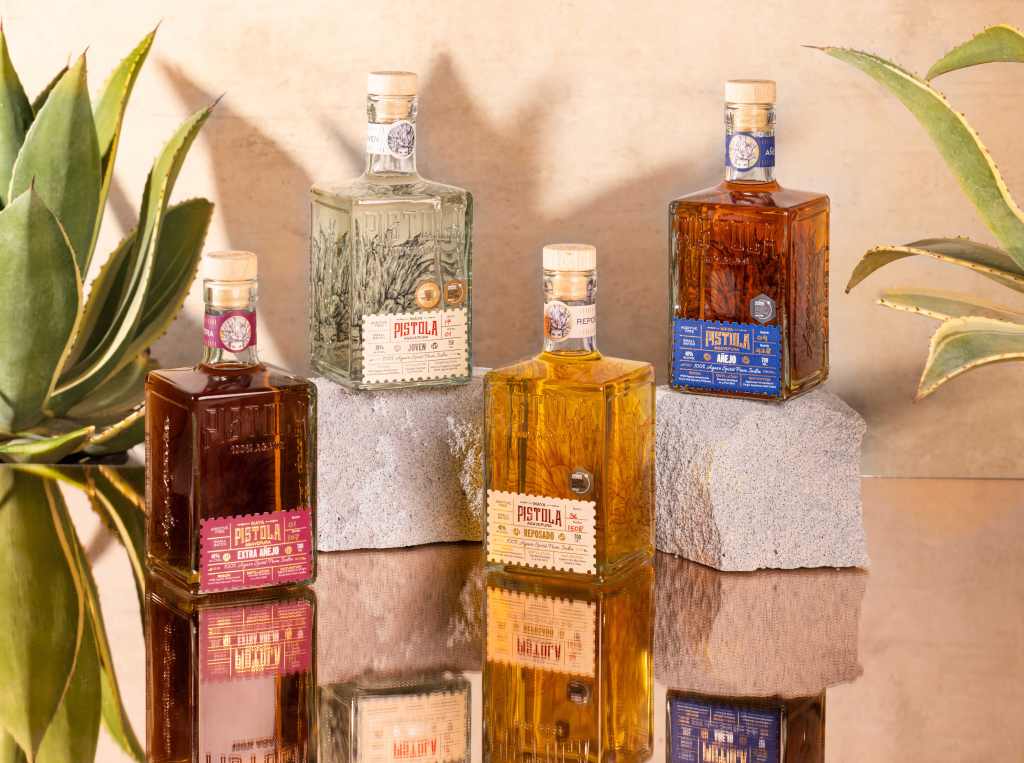
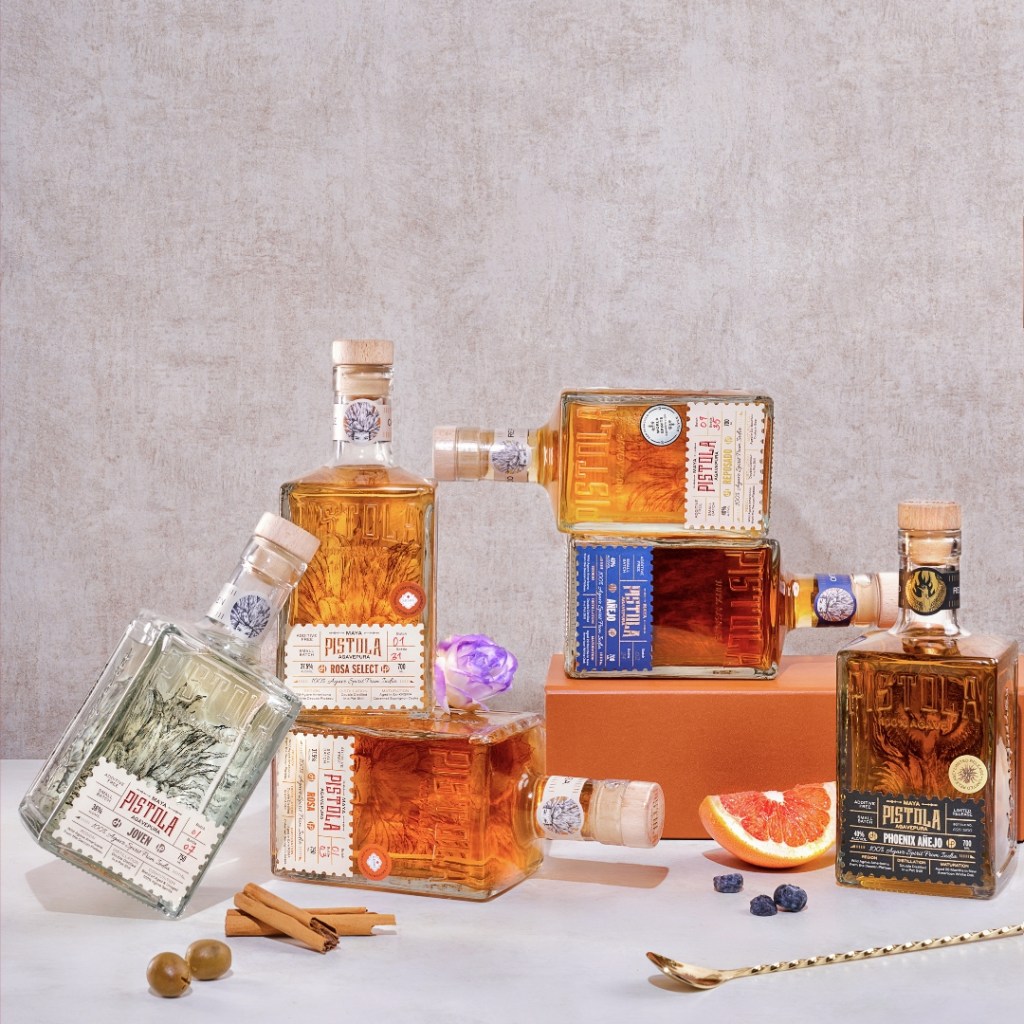
Looking at the portfolio, I believe you currently have the Joven, Reposado, Rosa, Añejo, and Extra Añejo. Could you explain the differences between them and how each expression develops from the previous one?
Our Joven is a blend of approximately 85% blanco and around 15% reposado. The exact reposado component depends on the type of barrel used.
Our reposado uses three different ex-bourbon barrel types, along with some new American white oak. We use a combination of Jim Beam, Maker’s Mark, and Woodford Reserve barrels. One of those ex-bourbon casks contributes to the reposado component used in the Joven.
We do this because it creates a spirit that is more mellow, less funky, and smoother overall. The Joven is bottled at 38% ABV, while the Reposado is bottled at 40% ABV.
After that comes the Rosa. The Rosa isn’t available in England because it was produced as a limited batch. It’s bottled at 37.5% ABV and aged exclusively in French oak barrels. These barrels are slightly larger at 225 litres, compared with the 200-litre American oak and ex-bourbon barrels we use elsewhere.The French oak imparts a spicy profile, and the barrels previously held Cabernet Sauvignon. It creates a really interesting expression.
We then have the Añejo, bottled at 40% ABV. For the Añejo, we use only new American white oak and no ex-bourbon barrels.
Finally, there is the Extra Añejo. This expression is aged for 30 months in new American white oak and then finished for six months in ex-bourbon barrels.
Some people find that unusual because it’s finished in ex-bourbon rather than some more exotic cask. The reality is that we simply achieve excellent flavour from those barrels. We weren’t trying to create something purely for marketing purposes by saying it was finished in sherry casks or something similar.
All of our barrels are imported from Kentucky, so it makes sense for us to work with what is readily available there. It gives us great results.
Having tried your portfolio at a recent mezcal and tequila festival in London, the Joven and Añejos were my favourites. I’m a big whisky drinker, and the Añejos really appealed to me.
Branching into whisky for a moment, India is obviously a huge market for Scotch. How is Scotch viewed in India today, and what other whisky categories are becoming particularly popular?
Scotch has been extremely popular in India for years. India consumes an enormous amount of whisky. In fact, several of the highest-selling whiskies in the world are Indian brands, possibly four, five, or even six of the top ten.
We consume a tremendous amount of whisky, and Scotch and single malts are highly respected. Indians love drinking those spirits. At the same time, among younger consumers and more affluent circles, we’re seeing increasing consumption of high-end tequilas, mezcals, and additive-free agave spirits.
We’re not taking major market share away from whisky, but there is a rapidly growing agave spirits fan base. In fact, the highest percentage growth for agave spirits globally in 2025 was in India, at 31%. The category is growing tremendously.
From what I’ve seen in the UK, it feels as though Britain is increasingly becoming a strong market for agave spirits. The US is obviously much further ahead, but there seems to be a growing groundswell here. What are your thoughts?
The UK is nowhere near the US at the moment. The US is operating on another level entirely. By around 2020 or 2021, America’s enthusiasm for agave spirits surpassed bourbon and vodka. Agave spirits have become one of the defining drinks categories in the country.
That said, there is definitely a growing appreciation for agave spirits in the UK. It is one of the few categories that continues to grow while some other categories are shrinking. For us, it feels like a very good time to be entering and investing in the UK market.
I believe Pistola has a couple of signature cocktails associated with the brand. How important do you think cocktails are in introducing consumers to new spirits, and how did you develop your cocktail programme?
The truth is that the entire on-trade sector functions as an experimental ground for what later happens in off-trade. On-trade is where sampling takes place. It’s where people first discover a brand before deciding to purchase it. Because of that, I think it is extremely important for us to have a strong on-trade presence.
That will be our primary focus over the next couple of years as we launch in the UK. After that, we will adopt a more traditional retail-led strategy.
Your products have won several awards as well. What has that process been like, and how do you decide which competitions to enter?
We recently won a Gold Medal with 95 points at the IWSC Awards, which is a prestigious recognition, and we’re extremely happy about it.
We also won Spirit of the Year from India at the USA Spirit Ratings in 2025. We’ve won a number of different awards. We continually monitor award programmes, submit entries, and see what happens.
Winning awards provides a huge amount of confidence to the team and gives our salespeople valuable tools they can use when presenting the brand. Most importantly, it reassures us that we’re doing something right.
Moving towards regulation, agave is obviously heavily regulated for both good and bad reasons. What are your thoughts on the regulatory side of things, particularly regarding mezcal and broader agave categories?
For us, there are currently no issues because we are entirely manufactured in India.
All of the regulatory discussions involving the CRT and CRM don’t directly affect us. If we eventually decide to produce tequila, mezcal, or another agave spirit in Mexico, then we’ll examine those regulations in detail. At the moment, they have no real impact on our business.
Do you have any broader thoughts on regulation within the industry? Do you think those frameworks are useful for protecting heritage, or do you think changes may be necessary going forward?
I think every regulatory body tries to do what it believes is right. The CRT and CRM, like all institutions, need to evolve over time.
It’s important that, while protecting heritage, they don’t inadvertently undermine some of the excellent work they’ve done in building these categories. They need to recognise changing realities and adapt appropriately. It’s difficult for me to prescribe exactly what they should do because I’m not in their position.
Ultimately, it’s politics, and politics is never simple. We’ve seen that ourselves with constantly changing prime ministers in the UK. It’s a challenging environment, so I can only imagine how difficult it must be for them.
What excites you most about the future of the brand? Are there any new products or initiatives you’re particularly excited about over the next few years?
We have a number of new launches coming up. However, for the UK market, our immediate focus is simple: getting liquid on lips.
The most important thing right now is getting people to try the product. Once people experience it, they begin developing an affinity for it. The way we make people truly fall in love with the product is by explaining how it is made and being completely transparent about every aspect of production. Once consumers understand that story, we know we’ve gained a customer for life.


Leave a Reply