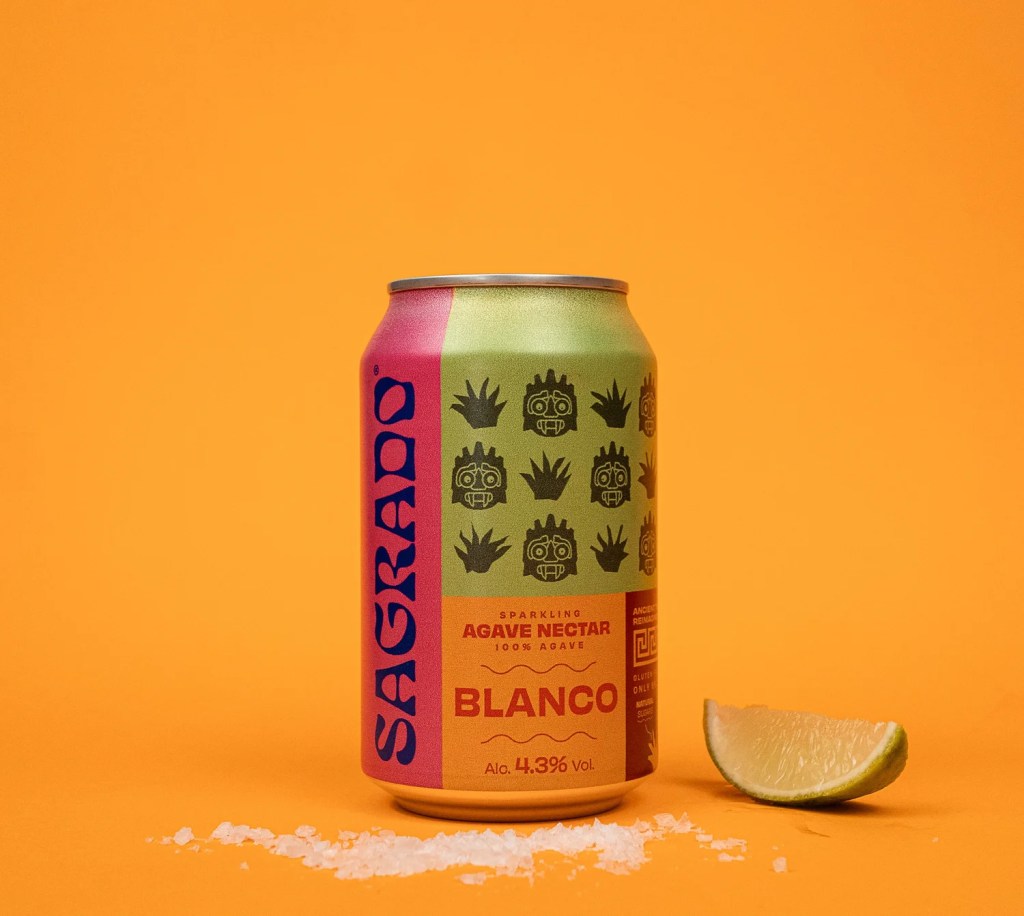
It’s no secret that tequila and mezcal have become the spirits of the moment in the 2020s and beyond. But they aren’t the only alcoholic drinks that can be made from the agave. Pulque is the mother drink from which also other Mexican alcoholic drinks flow, inspiring stories and brand owners from around the world.
Felix Jordan, founder of the UK brand Sagrado was drawn to the communal drinking elements of pulque. This inspired the development of Sagrado and the creation of a new category called sparkling agave.
Find out what sparkling agave is, the journey of Sagrado and what Jordan is working on in the future.
How did you get into the weird and wonderful world of agave spirits, and how did it eventually lead to you starting Sagrado?
My background is in booze and drinks on the bar side. I’ve been a bar manager in London and around the UK for the last 10 years, from all sorts of high-volume events to high-volume nightclubs and then moving more recently into mixology, liquid development.
Towards the end of that, that’s where I got more interested in agave spirits. Specifically when I came into that mixology side, I found them a lot more interesting to work with in terms of profiles and characters and the variance in different profiles, for example mezcal, which is like a rabbit hole of its own.
I went out to Mexico for the first time on a mission to understand agave spirits and not only the production process, but the history of them, and then started getting deeper down the rabbit hole and learned about pulque. It eventually led to the idea of Sagrado, which was from seeing a gap in the market where cider isn’t made in Mexico. If you’re gluten free or you don’t like beer, there’s no option for something that’s light and refreshing.
I was also struck by the knowledge of pulque and knowing that fermented agave beverages were drunk at a lower strength at the time of the Mesoamerican cultures. That’s not so much the case today in the everyday pub or bar. So that’s where the idea came from. It was to fuse the culture and the history of pulque at that 4% lower fermented agave beverage with the modern-day beer alternative that’s light and refreshing and crisp.
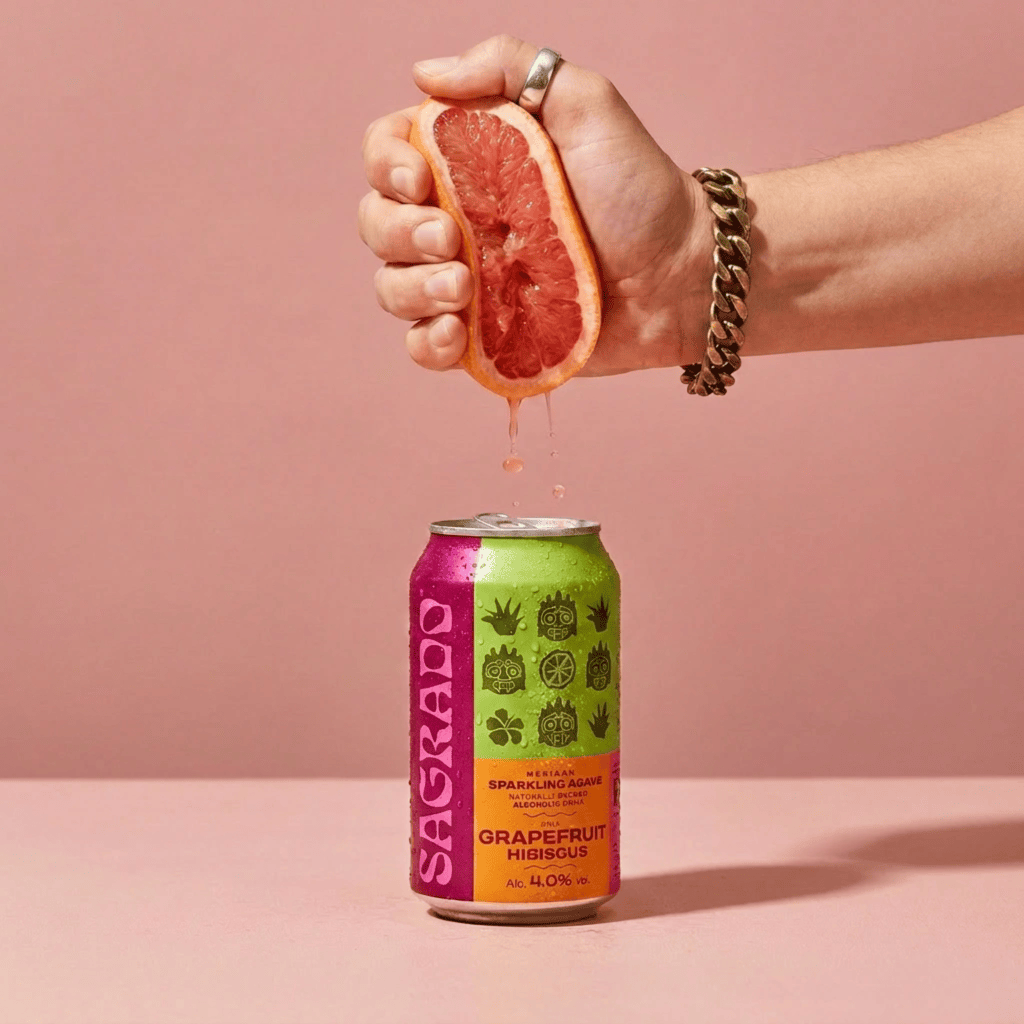
Image credit: Sagrado.
Tequila and mezcal seem to be more understood than pulque. What were your first thoughts when you tried it?
Honestly, traditional pulque was not to my taste. But how it’s made and how it appears in Mexico is fascinating. It’s fermented from raw agave sap, the kind of gooey sap, rather than mezcal which is fermented from the juice and made from the cooked piña. The texture of pulque is different too. Because it’s usually open-air fermented, you get a super yeasty flavour profile. Some can go really sour, some can stay quite neutral.
It’s very much a social drink. Just like you go to the pub, they have pulquerias around Mexico where you go and you sit down with your friends. It brings people together. It’s laid back and not pretentious.
In ancient times, it was always drunk at festivals and gatherings, and it was a holy, sacred drink. That ritualistic and social part was what inspired the pulque connection to Sagrado.
You define Sagrado as sparkling agave as a category. Is that a category you’ve personally coined?
That’s right. We’ve done a lot of back and forth and market research about what to call this new category. We’re the first people in the world to make this and to ferment agave and then carbonate it in this way. So there’s no box that we can slot into, and specifically when it comes to legislation in the UK and Europe, you have to call a brand something.
We didn’t want to call it an agave cider or agave beer and legally we couldn’t either. Sparkling agave felt right in that it describes exactly what the category is. As a sparkling cider would or a sparkling wine, sparkling agave feels like it’s its own category and that’s what we’re trying to build out. Whether that’s 4% in our style or whether that’s 8% in a wine style, they’re all a style of sparkling agave.
Let’s talk about the portfolio and the flavours.
We all use the same fermented agave base for all of our SKUs and then depending on our different flavours. We have blanco, which is our original 100% agave, crisp, light, refreshing. You get notes of pineapple from the cooked agave. It’s the most easy-drinking, everyday, lower-sugar variant.
Then we have our two newer flavours, which came out in the summer of 2026. Mango chilli, which is sweet and spicy. We only use agave to sweeten all our drinks as well. So it’s agave ferment and agave to sweeten, which gives it a sweet feel and clean finish. With our mango chilli, we add real habanero into the brew tank and then mango.
With our grapefruit hibiscus we use grapefruit oils and then add real hibiscus into the tank, so you get a cool colour and a lovely hibiscus tanninness. Blanco on its own was a lot harder to understand as a drink in itself, but our new flavours have a great profile to them which is a lot easier for educating consumers. People pick it off the shelf because they want the flavour and then they start reading it and realise that it’s made from agave and what it is.
What do you think of the culture of agave spirits in the UK? Do you think there’s a lot of excitement about agave spirits, a lot of interest on the consumer side, or do you think there’s a lot of way to go with education and what’s coming?
I think we’re very much on a trend, specifically with tequila and that’s a great for overall education.Mezcal still has a way to go, and it’s still very much a drink for bartenders or people that are enthusiastic and the people that know about it. Not because it isn’t delicious, but because the knowledge isn’t there and it’s quite an out-there drink, just as you get with other niche spirits.
London is at the forefront of the agave spirits culture with places like the Mezcal Mile. Places like Manchester and Brighton are becoming increasingly popular as well. It’s anywhere that there’s an interest in more diversity in terms of drinks and leading bars.
What are your thoughts on the regulations for tequila and mezcal? Do you think they’re a help or a hindrance, or do you think it’s a lot more nuanced for people in the industry?
In general it will always be a good thing to have protection over these certain spirits. How strict the protections are is another battle, and also how well-regulated they are is also a whole other topic, because the regulatory bodies have their hands tied just with Mexico and the US that they don’t even have the chance to look outside of Mexico.
I think for people that are in it for the right reasons and brands that are really trying to grow a fantastic tequila brand, it’s not so much an issue. I think they can be tighter in certain other formats. For mezcal producers, having protection does bring some benefits and gives them leverage for price and keeps that artisanal craftsmanship there.
In Mexico, you see these tiny little palenques, which is the entire livelihood of a family. At the same time, you’ve got huge conglomerates churning it out and there needs to be a differentiation between them.
In terms of the branding of Sagrado, what was the process for defining the colours, imagery and story?
We didn’t just want to design a cool-looking Mexicanesque can. We put a lot of thought into the design and that shows because we have a large Mexican following. If you look at the design of the cans, it’s very much colour-blocked, and that comes from Oaxacan architecture and the designs of the buildings in Oaxaca. The colour palette itself was taken from Frida Kahlo’s house in Mexico City. It’s the exact shades.
The logo, Tlaloc, is the Aztec god of rain and crop yield, controls the weather, so therefore if it rains more, we get more agave. So it’s the two main components of Sagrado, which is agave and water. We thought that was a great symbol to represent us.
In terms of wider trends in the agave spirits industry, anything that stands out to you? Sparkling agave will become more apparent as you build on the category, but you’ve got flavoured tequila, you’ve got other things coming through.
Generally, what do you think will become more prominent in maybe the next three to five years?
I think RTDs are going to keep growing very quickly in both tequila and mezcal. Flavoured tequilas are happening too. It’s like with gins. Gin was the big boom and then flavoured gins was the even bigger boom. I think that was driven more from your average everyday consumers, where I think right now tequila and mezcal are still more regularly used in bars and drunk in bars.
So I don’t think we’re going to see that flavoured tequila boom in supermarkets anytime soon. I think maybe agave liqueurs could become popular. Naturally, it’s a sweetened drink and it’s a great base for things. We make our own coffee mezcal liqueur that we sell in limited editions. There’s so much runway and it’s an exciting time for sure.
Where would you like to be with Sagrado in the next five years? Any new products you’d like to get out there? Any particular milestones you’re looking to reach?
We would like to be international and in supermarkets. Our main thing for our focus at the minute is getting into liquid to lips and getting into as many pubs and drafts as possible and getting to as many festivals as possible.
Right now with our core SKU, we’re going to keep pushing our 4%, and we think we’ve got a good market there. We are looking at limited-edition, 750-style champagne variants to do, which I think would be awesome as well as a wine alternative.
If you could change one thing about the agave spirits industry, what would it be and why?
It would be certain stigmas attached to agave spirits in the UK. Our only experience for the last 30 years of tequila is that we’re not being given real tequila or it’s cheap. The stigma that’s created is that people think it gives them bad hangovers and it makes them sick.
Whereas with gin, there’s a lot more trust because it’s an English concept and we treat it with respect. But because agave spirits come from so far away and there’s this unknown quality, that can make it a lot harder to change people’s minds.


Leave a comment