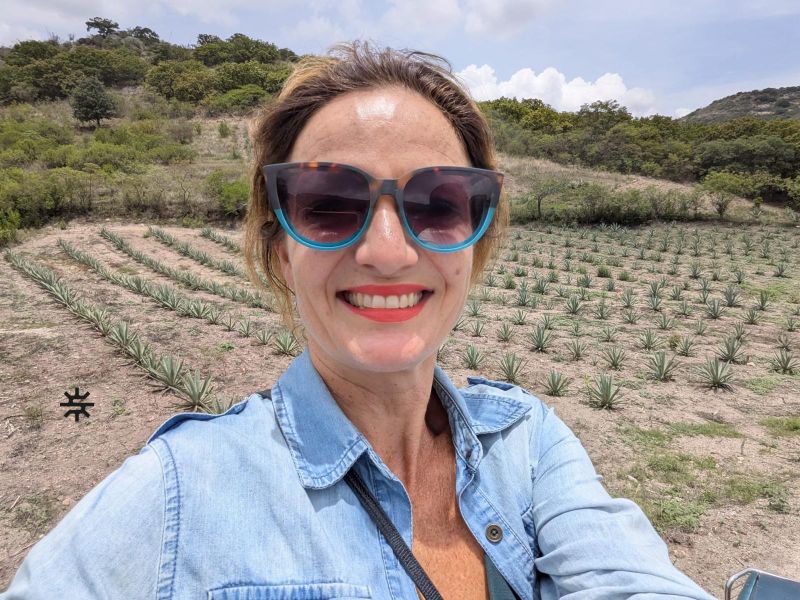
Agave spirits advocacy is a growing field across the world, with so many passionate people wanting to share stories of mezcaleros and open people up to new experiences with different brands.
Heidi Roach of the Mezcal Academy is definitely one of the most passionate mezcal educators in Europe. The Agaveist spoke to her about how to make agave spirits education as accessible as possible, the state of the industry is places like the UK and Spain and plenty more.
It’d be great to hear about how you got into this weird and wonderful world of agave spirits and what led you into it.
I really didn’t see it coming because I was a real gin and tonic drinker. Then, like lots of people, I started to see mezcal on cocktail menus and was brought into it that way. I was definitely a Mezcal Negroni girl first and foremost. I was supposed to go to Mexico in 2020 but couldn’t go, and ended up going in 2022. In the meantime, I was starting to get into it and trying to seek out other mezcal cocktails whenever it was possible during that period
I came back and thought, “Do you know what? I’m really fascinated by this.” There was something about it that felt so different. I’d never worked in spirits or wine, and I’d never done any courses in it, but I had this real inkling to know more. It was something that appealed to me because I could see there was something interesting about it. I’d worked in IT as a software developer and then as an agile coach for years and I thought I’ll do this online.
I found the Agave Spirits Institute (ASI) after searching to see whether it was possible to become a mezcal sommelier. I found that funny because somebody had once asked me during a team icebreakers, “What would you be doing if you weren’t an agile coach?” I remember saying, “I’d be a mezcal sommelier,” and everyone laughed. So, I did the ASI introductory course and I got the bug.
The courses were expensive, but I thought, What else are you doing? What other hobbies have you got right now? So I decided to start the programme. I did their Level One, which was the Mezcal Specialist course, and that covered a lot of the legal terminology, categories and classifications. It was pretty dry, but I still thought that if I was going to do more, become an authority on it and help other people learn about it, then I should go further. That’s why I put myself through the whole programme, which ended up with me going to Oaxaca in 2025 to do the master’s diploma course.
That was a complete intensive week covering everything from biology through to chemistry, and it was tough. There was a lot of blind tasting as well, and the blind tasting was always first thing in the morning. It was full on and by the end of the week, though, you just felt absolutely full of it. It was brilliant.
As part of my education as well I looked at a course on the anthropology of mezcal led by Vinik Juré. It was a wonderful complement to the formal ASI programme which opened my eyes to the depth of the cultural and sociopolitical elements surrounding mezcal’s history. Vinik is an exceptional teacher and the reading list for the course was amazing.
I’ve heard of the ASI. Would you say its educational approach is hands-on and down to earth? What are your thoughts on how it takes people through the subject?
I have pros and cons for it, and it’s certainly not for everybody. It’s very much focused on how to evaluate a spirit. Daniel and Oscar, the guys who set it up, approach it from a wine sommelier perspective, which makes sense because that’s their background. They wanted mezcal to receive the same sort of approach as wine because of all the terroir and the relationship between terroir and how the different spirits taste.
I think it’s very heavy on that approach, so for a lot of people it wouldn’t necessarily be what they wanted. If you’re already somebody who’s in spirits and you want to be on judging panels or do something along those lines, it’s extremely good because you get a strong understanding of what makes up the organoleptic profiles of the spirits.
For me, and probably for lots of people coming at it without that background or without that particular need, it’s a lot of investment, both in time and money, to gather the information that you need. I worked with the ASI for about a year after I did the course. One of the plans was that I was going to set up in Europe as the coordinator and leader here, but it was difficult to orchestrate, mostly because of importing the course kits. Each one comes with a real mix of samples, so it was quite heavy going to get logistics cleared
That was one of the reasons I decided to look at another way of teaching. I kept thinking that everybody should be able to learn, and everybody should have access to an accessible, affordable course. That’s essentially what I’ve done with Mezcal Academy. I wanted something that wasn’t necessarily aimed at people who need a certification or who are looking for belts and braces and want to learn how to become a distiller. It’s for people who want to feel more confident, understand why agave spirits are different and understand why I think they deserve a lot more respect than they currently get.
On your journey through mezcal and tequila, what brands have you come across that have become your go-to bottles? Is it the stories, the taste or something else that makes you like them?
A brand that is always surprisingly good value and very easy to get hold of in Europe is Derrumbes and I love them. I use the portfolio often when I’m hosting tastings with people who are new to mezcal because I think Derrumbes do a good job of showcasing the different states and different agave species. They’re affordable as well.
I love Cinco Sentidos. One of the great things about them is that when you turn their bottles around, the labels have got a massive amount of information on them, so you can learn loads about the way they do things.
I also like Burrito Fiestero. I’m not sure if we’ve got it in the UK yet, but I found it in a shop and thought, “Why is this so cheap?” You start wondering whether it’s industrial or what the story is, but it’s absolutely not. It’s a really nice cenizo from Durango and it’s great value.
Moving on to local culture, what do you think the current level of education is from a UK perspective around tequila and agave spirits, and what’s it like in Spain where you are?
Are there significant differences?
My experience would be that WSET is everybody’s reference point. That’s what people are looking for. I haven’t done any of their courses, but I have had some content shared with me, and my impression is that the agave spirits module is light. I don’t think they’re really getting into it. Personally, I’d love to work with them and help make the modules more interesting, giving them more flavour and more focus.
Aside from that, there are less formal things going on which are absolutely brilliant. I can’t say enough good things about Jon Darby from Sin Gusano and his Sorbito bar. I think he’s doing a wonderful job generally of telling people everything, and he’s so generous with his knowledge. I think that’s a great way to do it. It isn’t formal, but he’s doing these tastings where he gets people excited about all the differences, the small producers and the places he’s visited.
Some of the brands and their brand ambassadors do a good job as well, although I think that’s always difficult for them because they can only take it so far. They’ll go in and tell all the great stories and all the good things about their brand, but they’re inevitably missing things if they can only focus on one brand.
That’s why, for me, I want to try to be as brand agnostic as possible. I want to support small producers when I can, talk about them, bring in their samples for people to taste when I can, and bring the producers themselves in to talk to people as well. I’d love to do that.
Here in Spain, WSET is definitely the go-to as well. There are a lot of hospitality schools, and a lot of people come to Spain to learn how to bartend or to develop a particular layer or niche of hospitality. Agave spirits are being covered there, but in a really small way. I’ve been looking at it a lot to see whether there are any opportunities for me to do masterclasses or train-the-trainer programmes. I’d love to help people who are keen for more knowledge.
From the consumer side, when somebody comes to one of your tastings and has never had mezcal or tequila before, do you get the impression that people are open to new things?
They might not understand exactly what they’re drinking, but is there an interest in the story and the category?
Big time. I’ve done lots of tastings now, both in the UK and in Spain, and it’s always so nice because you get a real mixture of people. Sometimes I’ll have people who are from Mexico but have never had mezcal because it simply wasn’t something they would have found. If people have lived outside the country for even 10 or 15 years, it’s entirely possible they never went to a bar that had mezcal where they lived.
You’ve always got a couple of people who’ve been on holiday to Mexico and say, “Oh yeah, I’ve had mezcal,” but they definitely won’t have had what I’m presenting. Normally, when people are going on holiday, they’ve perhaps been to Cancun or somewhere like that and might have had a smoky espadín or something that’s a local fun bottle with a worm in it. Even people who go in a bit cynical will find something interesting, and that can often be the nerdiness of it and discovering just how rustic the processes are.
If I show people pictures of tahonas and open fermentation vats with flies everywhere, they’re just like, “What?” They can’t believe it. People almost think you’re making it up, and you have to tell them, “No, this is really how the majority of mezcal is made.” I tend to get a good mixed crowd in both places, and it’s always a delight. This is why I want to do it and why I love educating people, because you know you’re going to find something that they won’t know.
Even people who have been to visit a palenque or who have tasted lots of mezcal find that it’s never-ending. I don’t profess to know everything by any means. I still feel like I’m very much just learning. I went to Mexico recently and visited Santa Catarina Minas for the first time, where everything was ancestral and they were using clay-pot distillation, and I thought, “Bloody hell, this is nothing like what I saw last time I was in Oaxaca.” Every single little region has its own ways.
Mezcal is quite niche on its own, but then you’ve got bacanora, raicilla and sotol. What are your thoughts on those spirits?
Do you like them, and are there particular brands or styles you think people should be more aware of?
I like them very much, and I’m hoping we’ll get to see more and more of them. In my first course tasting kit, I’ve included a bacanora, which will be fun just to shake things up a bit.
Everybody’s saying that sotol is the next new thing and that it’s suddenly going to become more expensive because people are going to realise how exciting it is. I know from a cocktail point of view that people are very interested in using sotol right now.
Raicilla I’ve always described as challenging because some of them are so funky, cheesy and weird that they can be hard to like. I’ve recently had some delicious raicilla, though. When I was in Mexico City, a lovely lady called Claudia got in touch with me, and she’s got a brand called La Xamana. It was so different from any other raicilla I’d had before that I thought, “This is probably what I’d be tasting if I went to the raicilla region.” I was excited by that because I could suddenly see that I was going to like more of it. The more I taste, the more I’m going to find that I like.
Moving more into your consultancy background, I believe you’ve worked with Succulent Spirits. Tell me more about what that is and how you’ve become involved with their portfolio.
I was at a show called the Viva Agave show in Paris a couple of years ago. It’s a consumer show, and the Agave Spirits Institute had a stand there. I went along partly to tell other people who might be interested in doing their courses about it and also because Daniel, the founder, has his own mezcal brand.
We were talking about that, and I got to meet loads of interesting producers. It was a wonderful show because they had brought over loads of small producers. The ladies from Zinacantán in Puebla were right next to us, and I was a bit starstruck by that because it was such a special thing to be able to meet people I never thought I’d be fortunate enough to meet.
I went into the room next door and saw this guy with all these interesting things. He was talking, I was listening, and then I tried a little bit of what he was selling. This was Gaudéricq, one of the founders of Succulent Spirits. I chatted to him afterwards and we talked about how they try to find small producers and things that people might not have seen before, particularly things that weren’t already available in Europe.
It took almost two years, but Succulent Spirits eventually wanted to have a look at the Spanish market, so they got in touch. I’ve done some masterclasses out here with the products. Cinco Sentidos is one of the brands they’re working with, and they’re great because they work with lots of different producers.
Malbien is another one. They work with small producers and put the Malbien label on it, but they very much put the producer’s story out there so people can really learn about how it’s made and who the people are behind it, which I really like.
I started working with Succulent to help them establish the Spanish market and get the brands known out here, but I’m now also going to be working with them more on an education role. For example, if they have a distributor who is relatively new to mezcal and has a team that needs to learn, I can go and present masterclasses to them or potentially deliver the course as well.
Of course, tequila is something you can’t really get away from. What are your general thoughts on it? Do you like it, and where do you think it currently sits?
Is it oversaturated or in the right position?
I always feel a bit bad because I feel like I come across really snobby, but mezcal was my first love. I think so many of us in Europe have been burned by shitty mixto, and some of the stuff that we’ve had is poor quality. One of the things that makes me laugh is that Spain is on the list of the third-biggest consumers of Mexican spirits, or something ridiculous like that, and people think, “Oh my God, the market must be really great.” I think, “Yeah, but it’s all mixto.” That’s what people have been buying for years.
I’m not saying mixto is always bad, but what I am saying is that it’s generally not quality. We’re seeing a lot of sugarcane going into this stuff, and it’s not pure. It’s very different from our ancestral mezcals.
I don’t dislike tequila, but I would never buy a bottle of tequila to sip at home. I make palomas with tequila because I think a paloma should be tequila; it doesn’t go as well with mezcal for me. I make margaritas as well, and I’ve had some delicious tequila. There are great brands out there like Siete Leguas. Even so, if I could spend my money on a mezcal or spend my money on a tequila, I’d go mezcal every time.
From a regulation point of view, whether on the tequila or mezcal side, what do you think of the regulations generally?
Do you think they’re good or bad, or is there more nuance depending on the context?
I think there are huge amounts of nuance, and I completely understand why some producers are choosing not to become certified and put the word mezcal on their labels. Lalo Ángeles from Lalocurais one of the people who has done that. They want to do things their way, and I think that’s absolutely fair. If your family has been making mezcal the same way for 100 years, but you do one thing that isn’t on the list of approved things required to get the badge, and you genuinely believe that what you’re doing makes your spirit taste better, then I think you should be able to do that.
That’s one of the things I really want to make sure comes through when I’m teaching people. When they see something that says destilado de agave and it doesn’t say mezcal, that’s okay. It doesn’t mean it’s a lesser product. There can be legitimate reasons why a producer chooses to operate outside the certification system.
At the same time, people being dishonest and telling lies makes a mockery of the whole thing. If you say you’re 100% agave and you absolutely aren’t, then what’s the point of all this regulation that’s supposed to be there to protect the product? So I think it’s tough, and we’re going to keep seeing the regulations evolve.
From a celebrity point of view, what do you think about celebrity tequila and mezcal brands? Is that good or bad for the category, or is it nuanced?
It’s definitely nuanced. I think there’s a certain arrogance to wanting to put your face on the bottle instead of the people who’ve made it. I want to look at the bottle and see the names of the people involved, not just the master mezcalero or perhaps a few people from the team. I’m all about the team. I was an agile coach, so that’s what I want to know. It’s never just one person.
A celebrity could absolutely help a business sell its product, and that’s wonderful, but I think it’s really important that we still get to know the product itself and the people behind it.
Take Casamigos, for example. George Clooney is great, but we’ve seen that the product hasn’t necessarily represented the best of things. I would much sooner see celebrities find a brand that already exists, or find a small producer, and say, “Your stuff is lovely. Let me help you sell it.” Put the producer’s company logo on the label, put a photograph of where they’re making it on there, and give those people visibility. That would be my preference. That’s just me. I’m traditional like that.
You’ve got your Agave Spirits Discovery course, which I assume will be the first of many. What can people get from it, how is it run and what do you hope people come away with once they’ve finished?
What it’s really about for me is people having confidence. Anybody can be working in a bar and think, I still don’t understand this. I want the course to be accessible from that point of view, so people aren’t relying on having a big budget from their employer. If you work in a small bar, you might not be able to get somebody to pay for your training, so I want people to feel like they can afford it themselves.
That’s why it’s important to me that the tasting comes with the course and that people have the samples there. They can use a little bit during the session and then taste them again later, so it feels to me that people are getting good value from it.
I want people to learn and understand the process. There’s going to be a certain amount of theory about how everything is made, comparisons between the different types of spirits and as much as we can fit into two and a half hours. I also want to get across that there is a responsibility on everybody. There’s a sustainability element to mezcal, but there’s also a responsibility on us to pass knowledge on.
For bartenders, understanding the impact that always having one particular agave, for example, might have on the future of the category is important. If they can explain that to a consumer something like “you might love espadín, but have you tasted this? Let me tell you why, let me tell you about the profile, let me tell you about the village”, it creates such a better experience for a guest in their bar. That’s why I think the sommelier approach is important.
There’s a lot of emphasis in my course on terroir. How soil, altitude and the processes people use impact the final spirit, as well as the people who are touching it. Mezcal involves a lot of microbes, and all of those things contribute to why it tastes different.
What excites you about the mezcal category?
Where do you think it could go over the next couple of years, particularly in terms of trends, and where would you like to see Mezcal Academy go?
I’m super excited about the community element of it. One thing I’ve really seen is how generous some people are with their knowledge, and I love that. In London, where Jon Darby is, they call it the Mezcal Mile. You walk a few steps down and get to Corrichio’s, and everybody in there is so welcoming. Everybody wants you to come in and taste agave and tacos and things.
That’s happening everywhere. Wherever there are these little pockets of agave nerds, they all want to talk to each other. They’re always saying, “I’ve got this. Do you want to come and taste it?”
One of my now-best friends is Rachel. We’ve got an Instagram account called Agave Amigas, and we went to Mexico together and are doing a lot of tastings together. We met because she had an agave spirits bar in Edinburgh, and we do a lot of nerding out together.
When we were in Mexico, every time we met somebody there would be something else happening and more people wanting to get involved. I’d like to see that evolve. Moses at Los Catadores de Agave is also doing a really great job of hooking people up, introducing people and bringing people along to tastings who maybe don’t know anything about agave spirits. He’s more tequila-focused, but he’s gradually expanding into all of the different spirits.
I’d love to see us give more of a voice to the people who are making these spirits. I’d love it if my course became a roaring success and people said, “I want more. What can we do?” We could perhaps start having more online get-togethers where people who are interested can come along, taste something together and talk about what they’re tasting. We could bring producers along to tell us how they do things differently, and I think that would be a really nice way to build interest.
Then, for people who can afford to, if they want to go and visit these producers, let’s see if we can find ways to make that happen. It doesn’t have to be formal, with an exam at the end. I think people learn well when they go somewhere and see and smell things because everything stays with you.
Community is super important, and everybody I speak to in Mexico loves that. They love that we care and that we want to hear from them.
From a trend point of view, I’m seeing things such as non-alcoholic agave spirits becoming more of a thing, as well as flavoured tequilas. What do you think of those, and are there other trends you’re seeing?
I think it’s all good because anything that introduces people to agave is great. The non-alcoholic category is massive now and it’s only going to keep growing, and some of the things coming into that category are brilliant.
I just think we shouldn’t get too carried away with the flavours. Look at what happened to gin when they went a bit too far with that. We ended up with too many flavoured things, and then we lost some of the natural goodness. With agave, that’s so much more important.
The whole point of it is that we taste the earth, we taste the plant and we taste the agave itself. I’m therefore against anything that’s going to cover that up because I want us to taste the good stuff.
For more information on Heidi’s work, you can go to mezcal.academy and check out @agave_alegria on Instagram.


Leave a Reply