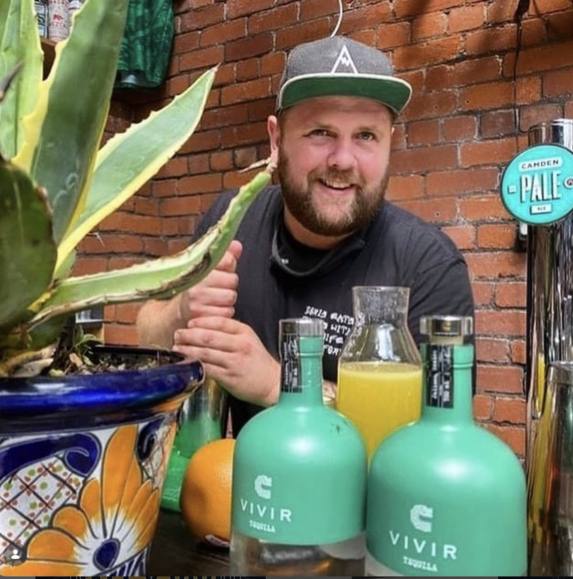
Tequila culture in the UK has come a long way in the last fifteen years in terms of consumer interest and education. British-owned tequila brands have been a major part of increasing the interest. A brand at the forefront is Vivir Tequila.
The Agaveist spoke to Joe Wild, Head Of Brand Advocacy at Vivir, to understand how important brand ambassadorship is with agave spirits and what makes Vivir such a memorable brand.
Let’s start with your discovery of tequila and how your opinion of it might have changed through the years of your work.
I’m originally from a place called Rhyl in North Wales, which is a small seaside town. You first start going out at 16 in these small towns, and you drink tequila. We all do the salt and lime thing. You have a shot and think, “Isn’t that gross?” I remember thinking exactly that, but it was more about the ceremony of it. That was part of the whole Jackass era. We were all skateboarding kids, so it was just a fun thing to do.
I moved away when I was 18, going to Leeds, where I started bartending, mostly in comedy clubs and student clubs. Tequila wasn’t a big part of that. It wasn’t until I moved to Liverpool and started working in venues there that I came across the craft cocktail boom in the UK. There was the whole speakeasy revival happening around 2015, and that’s when I first came across Tapatio.
The more I got into bartending, particularly the nerdier side of it, the more I started opening myself up to different products. It’s like anything in the world: the more you learn, the more you realise there’s so much more to discover. I ended up working in a bar called El Bandito in Liverpool, which was a tequila bar. That was mental. It was open seven nights a week until 5am, and it was always packed.
When I joined, they weren’t selling much tequila because it was known more as a late-night party spot. We started the process of changing that, while I was learning more myself. A few trips to Mexico helped, as did getting more involved in the tequila community in the UK, going to trade shows and meeting people.
I’ve now been involved in tequila brand ambassador work for around ten years. I’ve had my own tequila bar and Mexican food concepts. It’s all developed into something I never saw coming. It was such an organic thing.
Tell me about how you became the brand ambassador for Vivir tequila.
When Vivir came out in 2019 I was working for Altos Tequila, which is a great tequila and one I still love. I was in a tequila bar in Sheffield called Piña and Vivir was on the back bar. I presumed it was probably awful because, when you see a new brand come out, your tequila snobbery kicks in straight away. You’re clutching your pearls, thinking, “All right, who’s made this? Where’s it come from?”
I tried the blanco and thought, “Christ, this is good.” I really like grassy, mineral-rich, green tequilas. They’re a little lower on the citrus levels but have more minerality.
I was given Paul, my now-boss’s phone number there and then. At the time, it was him and his bag, going around venues handing the product out. On the train back from Sheffield to Liverpool, I texted Paul to say I liked Vivir.
After that, I’d see him at trade shows, bar openings and other industry events. If I spotted Vivir anywhere out in the market, I’d send him a text to let him know which bar was stocking it. It’s not an entry-level product, so there’s a price point to it, and I wanted him to know where it was appearing.
I was also taking part in Class Bar Magazine’s Bartenders’ Brand Awards, where you try spirits blind, rate them, get told the price, rate them again, see the bottle and then rate them once more. They then dish out the awards. One year they held it in Liverpool, just before COVID, and Vivir won loads of awards. Everyone loved it. As I was leaving the room, I texted Paul to say, “Hey, I’m in the room right now. Just so you know, Vivir has won a few awards.”
Then COVID happened, and I was made redundant from Pernod Ricard. I didn’t know what to do because hospitality was in such an uncertain position. Nobody knew what would come back, what the industry would look like or when things would reopen. I thought I’d do something for myself. I had enough redundancy money to cover the mortgage for a few months, and there weren’t many Mexican places in Liverpool at the time.
I’d opened bars for other people lots of times, and I’d been in the industry long enough to know what I was doing. So I decided to start my own catering company. I literally got a bain-marie, a hot plate, a table, a gazebo and a slow cooker. I did everything in that slow cooker. I’d approach venues in Liverpool that didn’t serve food and say “Let me do a Taco Tuesday” or “Let me come in and do something.” In return, I’d give them 15 or 20 per cent of whatever I made.
That got me into the venues, and then I’d start hammering the socials and building things up. It slowly evolved into Picante. During one of the lockdowns, I was also doing food through Uber Eats and Deliveroo from a bar in town. The bar was closed, but the owner was a friend of mine, so he let me go in and set everything up. I’d close the door behind me, put the food together, watch TV and films, and sit waiting for orders to come through on my laptop.
That’s when Paul rang me. Vivir needed a brand ambassador and that they knew I loved the brand and liked what I was doing. I started working for Vivir one or two days a week, and then El Sueño came along as our speed-rail option. My involvement grew from there, and I’ve been full-time with them for a few years now.
We now have Vivir, El Sueño and a brand called Moda as well, which is more of our party tequila, aimed at a younger crowd.
What’s the story of Vivir and what is the product range like?
Paul wasn’t into tequila at all to begin with. There used to be a nightclub or bar in Liverpool called Cava, where they did £1 shots of Sauza. What they did was buy Sauza and flavour it themselves in the bar. The back bar was full of bottles of Sauza with all sorts underneath them: baked beans, Skittles, toffee, chilli and everything else. You could get seven shots for a tenner, and it was huge with the student crowd. Paul used to go there and absolutely hated it. His neck would swell up, and he’d go red and blotchy. That’s when he discovered he had an allergic reaction to the tequila.
Later in life, Paul started a health-food brand and was always a big health nut. He then started importing agave syrup from a distillery that we use. When you’re importing that much agave syrup, you need all your paperwork properly sorted with the CRT. The last thing they want is someone importing loads of agave syrup and then fermenting and distilling it in the UK to make some sort of black market tequila. Everything had to be properly documented, so Paul was travelling back and forth and working with people out there.
Once you’re spending time in Mexico, you start trying good tequila and realise there are levels to it. He also found that the bars he was visiting couldn’t necessarily get hold of great 100% agave tequila. That helped lead to the idea behind Vivir, and it’s evolved from there.
What’s interesting about Vivir is that we only ever use Jack Daniel’s barrels in particular for the reposado and añejo. When I worked for Altos, they used a variety of bourbon barrels. That’s what most producers do. I’ve also visited other distilleries, and I remember thinking it was amazing that Ocho used barrels that Tapatio had already used, because it’s about the flavour profile you’re after. That’s another approach to barrel selection.
We use Jack Daniel’s barrels, but we don’t treat them. The alligator char stays in there. A lot of producers will get barrels and, once they’ve put them back together, they’ll clean them or strip them. You can treat barrels in different ways, and as long as you’re within the regulations for reposado and añejo, there’s room to work with them.
As a result, our reposado is heavily influenced by bourbon notes. You’re still drinking agave and tequila, obviously, but you get those toasted banana, nutty and caramel notes. What’s really interesting is the difference between that and the añejo. The reposado spends six months in the barrel, while the Añejo spends 18 months.
By the time you get to the añejo, it’s dried out completely. I think of it as more of a Speyside Scotch type of vibe. There’s a lot going on, and it makes you work a little harder to understand it.
When I do tastings, I always ask people whether they’re more of a brown-spirit drinker, someone who enjoys rum, bourbon and brandy, where there’s a little more sweetness going on, or whether they’re more of a Scotch drinker. If you’re into those sweeter brown spirits, you’ll love the reposado. If you’re more of a Scotch person, I don’t think you’re necessarily going to love the añejo.
And of course we have our baseline blanco that goes down a treat as well.
An interesting trend I’m noticing is the idea of New World agave spirits that are being made outside of Mexico in places like Scotland, India, South Africa and Italy. What do you think of the trend?
First it makes me appreciate the agave plant itself and how versatile it is. This plant can grow in so many different places.
I’m into the idea of different places making agave spirits. Why not? Tequila is from Tequila, and we know the five states and all the regulations around it. That’s locked in, and it’s not going to be challenged by an Italian agave spirit. But why not have a hyper-local agave spirit made in another part of the world? I don’t see the problem with it.
People love to shit on anything new when it comes along and ask, “What’s the point?” But there are lots of reasons to do it. It could even benefit tequila in the long run. Think about what would happen if there were a blight, like when phylloxera happened, and all your agave was wiped out in Mexico. There are agave strains growing all over the world that could potentially help repopulate it. That’s a terrible worst-case scenario, and I’m sure there are much smarter people than me making sure something like that never happens, but it’s another reason not to dismiss the idea.
The only problem I’ve found with New World agave spirits is accessibility at the price point. You try something and think, “Yeah, that’s interesting,” especially if you’re an agave nerd. But then it’s eighty quid a bottle. At that point, you’re competing with me buying a bottle of Fortaleza.
If I’m going to spend £70, £80 or even £100 on a bottle, I’m not doing it on a whim just because something is interesting. When I’m spending that sort of money myself, I want to love the liquid. That’s the only thing I think could slow the category down.
If you could get a bottle of Australian agave spirit, or whatever you want to call it, for under £30, then we’re talking. That’s when we could really set the world on fire and do something interesting.
Until that happens, it’s probably going to be something that agave nerds like me are interested in. I’ll always try something new when I see it in a bar. If I see an Indian agave spirit, I’ll try it just because the idea sounds brilliant. But when you’re looking at £10 a dram or £70 to £80 a bottle, it becomes much harder to sell something that the customer doesn’t already love.
In terms of the level of knowledge and interest from general consumers in the UK, there seems to be a lot of interest in tequila and mezcal to a lesser extent.
What have you seen on the ground as a brand ambassador?
Loads and loads. Even when I was working in party bars years ago, people would ask for a margarita. No problem, you’d make it, they’d knock it back, and that was that. Pretty much every bar would have a margarita on the cocktail menu.
But you can see the category evolving. First, you started seeing more bars putting a paloma on the menu. So where there was once only one tequila drink, now there were two. Then you had three with the spicy margarita. Those are now staple, no-frills drinks. My mum, my aunties and random people walking into a bar know what a paloma and a spicy margarita are.
If they go into a really good cocktail bar, they might then be introduced to a Tommy’s Margarita. So now we’ve got four tequila-based cocktails, whereas 15 years ago there was arguably only one. That shows how much the category has evolved, because those drinks wouldn’t be on menus if people weren’t buying them. I have a bar myself. I buy the tequila from the wholesaler, and you’re not going to buy a product you know isn’t going to sell.
I’ve definitely seen people become more knowledgeable. Celebrities getting involved helped the category a few years before COVID. It got more people interested, and some of them pushed the idea of 100 per cent agave tequila heavily. That meant people started asking questions. They wanted to know what 100 per cent agave meant, and guests now know to ask about it.
Mezcal is a few years behind tequila. A lot of it comes down to price, because mezcal is more expensive than tequila, as it should be. It would be terrible if you could get mezcal for under £20 a bottle.
But I do find guests coming into bars and asking, without being prompted, “Can I have a mezcal margarita?” They presume you’ve already got mezcal on your speed rail. That’s how familiar some demographics have become with it. I find it’s mostly a younger demographic, generally people in their thirties and under, perhaps stretching to 35.
With mezcal, though, we’re still at the stage where people ask for a mezcal rather than knowing whether they want a particular brand, a particular style or an espadín mezcal. But that’s how it starts. Mezcal is on the table, but it’s so new to the table. Imagine going back to the 1990s and someone bringing out sriracha. Everyone’s head would fall off.
So we’re getting there, and tequila is much more advanced, but the language is developing. Social media has helped massively. Most people are on social media now, and I see far more tequila content than I did years ago.
We even have tequila influencers, which is mental when you think about it. Before lockdown, your tequila influencers were Tom Estes and Julio Bermejo. They were the guys travelling around the world with a suitcase. They were the people you looked to for information.
Now, it’s much more readily available in your hand. You can learn about highland and lowland tequila. The more accessible that information becomes, the more accessible the category becomes, and the more it evolves. I don’t think anyone can be sad about that.
There are always going to be snobby dickheads. That’s just going to happen, and that’s fine. Usually, they outgrow it. I’ve found that after a few years, people get to a point in their careers where they realise that if people are paying them money, they can drink whatever they want however they want. That’s definitely the point I’m at now.
For how tequila is regulated do you think the rules and laws are good, bad, or does it depend on who you ask?
It depends who you ask. If you ask Agave Matchmaker, for example, the CRT recently came round and knocked on his door and cleared them out.
The CRT do what they do and keep things in line. That’s important. Without regulations, it would be absolutely mental. We’d be drinking a lot more agave made God knows where, and tequila wouldn’t have the recognition and accolades it gets.
But for tequila to evolve, it’s in a difficult position. It takes roughly seven to nine years for the agave plant to mature. Think about other categories, such as corn or potato spirits. You can make something wacky, experiment with flavours and grow the market quickly because you’re getting two or three harvests a year. You can experiment, make something like Fireball, and it can take over the world.
You can’t approach tequila in the same way. If it takes eight years for your product to come out of the ground, you’re going to be a lot more careful about what you do with it. You don’t want to spend eight years growing something and then mess it up.
It’s a catch-22 situation. How does tequila evolve? Cristalinos are ticking over, and I’ve been told they’re big in Mexico. When I go over there, I see adverts on billboards and things like that, although you don’t see them in other parts of the world. Perhaps that’s because our agave markets aren’t as developed as Mexico and America.
I do see more growth in tequila liqueurs. There’s an opportunity in that shot market because that’s part of our culture in the UK. The way people first get into tequila here is often through those disgusting £2 student shots.
Tequila Rose is probably going to be someone’s first tequila experience. There might be more opportunities to evolve the category through products like that and get people into drinking nicer tequila.
Ultimately, everything I talk about with tequila comes back to the plant. If it takes that long to grow, why make it taste like port? That’s why you don’t see loads of port-cask-finished tequilas. Patrón do some, Herradura do some, and they’re amazing, but there’s a reason you don’t see more of them. The guys in Scotland know how to make a sherry-cask-finished spirit. I’ll let them do that.
I think tequila will evolve and get into more people’s hands through cocktails. Think about the picante. You get a spicy margarita, and then the picante is a variation on it. The picante is arguably a modern classic. That wasn’t around 15 years ago. Whatever the next drink is, I think that’s where the category will evolve. It’s about how people are drinking tequila.
What personally excites you about tequila in the next five to ten years, whether it is from a brand ambassador perspective or for what you would like to do with tequila as an individual yourself, with any of the concepts you’ve got going on?
What excites me most is that people are now genuinely interested in tequila. I’ve been around long enough to remember when you had to force people to spend an extra pound on a shot and get them to drink something off the back bar rather than the speed-rail option. Now people are much more willing to do that.
I love seeing more tequila trade shows as well. Years ago, that wasn’t really a thing. You might get one every 18 months that was specifically about tequila. Usually, you’d go to a big trade show like NRB or Imbibe, and there would be two tables of tequila, normally with brands you’d seen 5000 times before.
Now, whenever I go to a trade show, there are loads of new brands I’ve never seen before. There are loads of people trying new things, and most of them are doing good stuff. Tico is a brand I’m loving at the moment. I think they’re doing really cool stuff and making great liquid.
Sagrado is another example of the kind of thing I find exciting and what they’ve done to create a new category of sparkling agave. I remember getting it into a venue because it was what I liked, not necessarily because it suited the people coming to it. Sagrado took off and everyone loved it!
It’s that evolution of things you have no idea what is coming down the line that excites me. That’s why you leave it to these really smart, creative people. They do their thing, and I will probably love it and push it!


Leave a Reply